

Doomsday clock set to a record 85 seconds to midnight
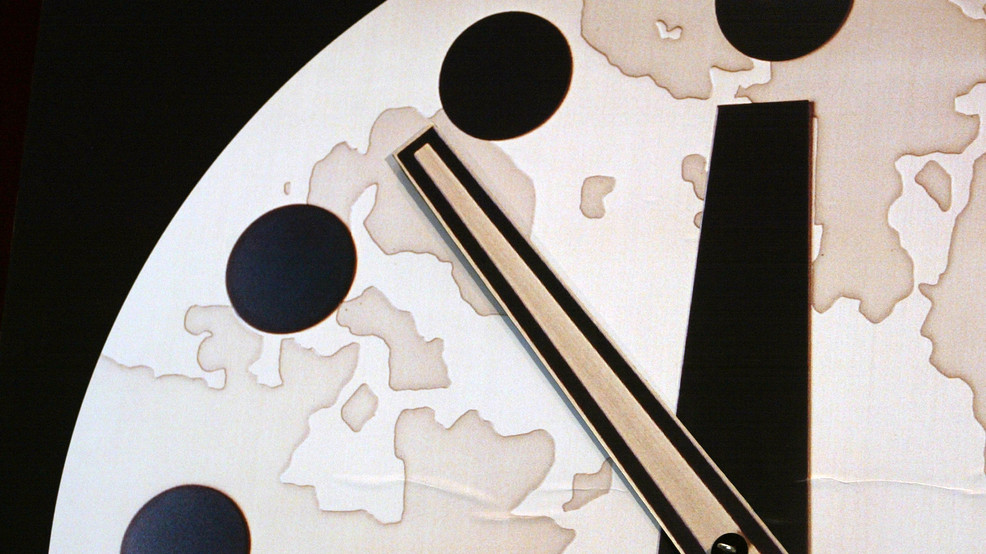
WASHINGTON (TNND) — The Bulletin of the Atomic Scientists set the Doomsday Clock to 85 seconds to midnight for 2026.
The Doomsday Clock is a design that warns the public about how close we are to destroying our world with dangerous technologies of our own making. It is a metaphor, a reminder of the perils we must address if we are to survive on the planet,” according to The Bulletin of the Atomic Scientists.
During a live web stream and virtual press conference, the seven speakers—most of whom have seats on the Science and Security Board, which sets the time on the Doomsday clock—pointed to AI, nuclear power, climate change and biological challenges as they explained their set time.
“In every area, we have failed to take the steps that are necessary to reduce risks, and there are new developments in every area that make the risks greater,” said Steven Fetter, a Professor of public policy at the University of Maryland and Science and Security Board member.
In 2025, the Doomsday clock was set to 89 seconds to midnight, a previous record broken by this year’s time.
Cofounder and CEO of Rappler, professor of professional practice at Columbia University’s School of International and Public Affairs (SIPA) and 2021 Nobel Peace Prize Laureate Maria Ressa gave key remarks after the time was set, before the Q & A.
“We are living through an information Armageddon,” said Ressa. “That’s brought about by the technology that rules our lives. From social media to generative AI, none of that tech is anchored in facts.”
She said humanity can no longer agree on the problems it faces, and thus, solutions are impossible to manifest, due to the predatory tech practices that fuel misinformation and disinformation.
At the end of the press conference, however, all speakers stressed that there are still ways to claw back time.
“We are fully capable of turning back the clock,” said the Chair of the Science and Security Board, Daniel Holz. “The tools needed to reduce the existential threats exist; what we lack is international cooperation, political courage and a global citizen call to action. Every person everywhere has a stake in addressing these threats.”